As solar energy becomes a mainstream solution for residential, commercial, and industrial applications, many people often encounter the terms solar panel and solar module and assume they mean the same thing. While closely related and sometimes used interchangeably, there are subtle technical and industry-based differences between them. Understanding these differences is important for system design, purchasing decisions, and working with a professional solar module supplier to ensure the right product selection. In practice, both are essential parts of photovoltaic systems that convert sunlight into electricity, but their definitions and usage can vary depending on the industry or manufacturer.
Definition and Basic Concept Differences
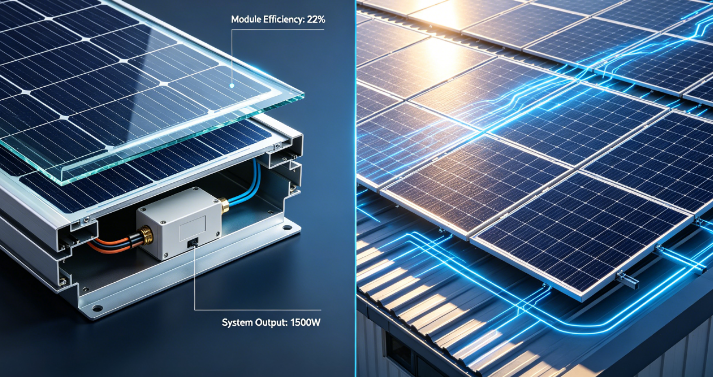
Although solar panels and solar modules are often used in the same context, they are not always identical in technical terminology:- Solar module as a basic unit A solar module refers to a single, factory-assembled unit made up of interconnected photovoltaic cells sealed within a protective frame and glass layer. It is the fundamental building block of solar energy systems and is designed to generate direct current (DC) electricity.
- Solar panel as a broader term A solar panel can refer either to a single module or a group of modules assembled together into a larger energy-generating unit. In many real-world applications, “solar panel” is used as a general marketing or consumer-friendly term.
- Industry usage variations In technical engineering documents, “module” is more precise, while “panel” is commonly used in commercial and residential discussions. This difference often leads to confusion among end users.
Structural and Manufacturing Perspective
From a production standpoint, both solar modules and solar panels share similar materials and manufacturing processes, but their application scale may differ:- Photovoltaic cell arrangement Solar modules are built by connecting multiple silicon-based cells in series and parallel configurations. These cells are responsible for converting sunlight into electrical energy efficiently.
- Protective layering system Each module is encapsulated with tempered glass, EVA film, and a backsheet to protect against moisture, UV radiation, and mechanical stress. This structure ensures long-term durability.
- Panel assembly interpretation When multiple modules are installed together on rooftops or solar farms, they are often collectively referred to as solar panels, especially in large-scale system design and installation projects.
Performance and Application Differences
In real-world applications, the distinction between modules and panels becomes more about system configuration than physical difference:- Energy output scaling A single solar module produces a fixed wattage output, such as 400W or 550W. When multiple modules are combined into an array, they form a solar panel system capable of generating higher total energy.
- Installation flexibility Modules are modular by nature and can be arranged in different configurations depending on roof size, ground space, or industrial requirements, making them highly adaptable.
- System-level interpretation In commercial solar farms, operators often describe the entire installed structure as panels, even though it consists of thousands of individual modules working together.
Market Terminology and Supplier Perspective
In the solar industry supply chain, terminology usage can vary depending on manufacturers, distributors, and clients:- Procurement language differences Buyers often communicate with a solar module supplier when sourcing individual photovoltaic units, especially for OEM or large-scale engineering projects.
- Branding and marketing usage Many companies use the term “solar panel” in marketing materials because it is more widely understood by residential customers, even when referring to modules.
- Technical documentation standards Engineers and manufacturers typically prefer the term “module” in specifications, datasheets, and performance reports to ensure clarity and precision.
Key Similarities Between Solar Panels and Modules
Despite their terminology differences, solar panels and modules share many core characteristics:- Same energy conversion principle Both rely on photovoltaic technology to convert sunlight into electrical energy through semiconductor materials.
- Identical core materials Silicon wafers, glass coverings, and conductive metal contacts are used in both structures, ensuring similar durability and performance standards.
- Unified system integration Whether called panels or modules, both components are designed to integrate into inverters, batteries, and grid systems to form complete solar power solutions.