
Managing an aerial roots ficus bonsai requires more than basic watering and placement—it involves precise shaping, careful monitoring, and the use of specialized tools to guide aerial root development. Aerial roots are one of the most distinctive features of ficus bonsai, but without proper tools, it can be difficult to control their direction, density, and overall aesthetic. By using the right tools, growers can enhance both the health and artistic value of their aerial roots ficus bonsai while maintaining balance and structure. Understanding which tools to use and how to use them effectively is key to successful bonsai cultivation.
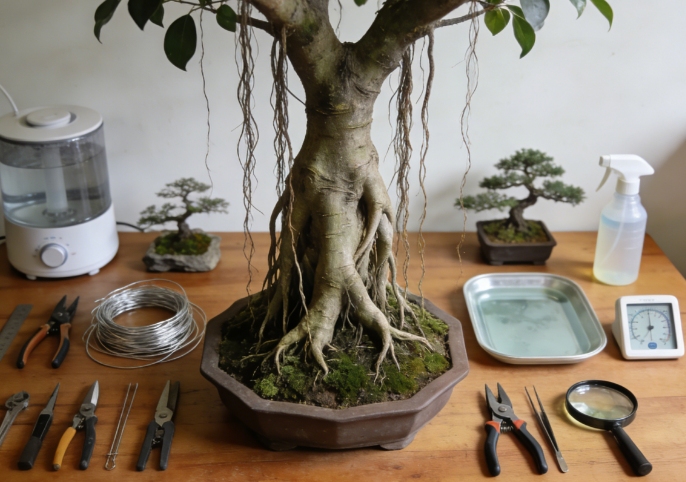
Essential Cutting and Pruning Tools
Pruning tools are fundamental for controlling the growth of aerial roots ficus bonsai and maintaining the overall shape of the tree.- Concave cutters for precise cuts:These tools allow clean and smooth cuts on branches and aerial roots, reducing scarring and promoting faster healing. Clean cuts also help prevent infection and encourage healthy regrowth.
- Sharp pruning shears: Ideal for trimming small branches and controlling excess foliage, these shears help redirect the plant’s energy toward aerial root development instead of unnecessary leaf growth.
- Root scissors for detailed trimming: When working on aerial roots that have already reached the soil, root scissors allow for careful shaping without damaging surrounding roots or disturbing the soil structure.
Wiring Tools for Shaping and Training
Wiring is one of the most important techniques for directing the growth of aerial roots ficus bonsai into desired shapes.- Aluminum or copper bonsai wire: These wires are flexible yet strong, allowing you to bend and guide branches and aerial roots without breaking them. They help position roots to grow in specific directions.
- Wire cutters for safe removal: When wires become too tight, wire cutters are used to remove them without damaging the bark or roots, ensuring the plant remains healthy.
- Protective wrapping materials: Sometimes soft materials are used under the wire to prevent marks or damage, especially when shaping young or delicate aerial roots.
Humidity and Moisture Control Tools
Since aerial roots ficus bonsai thrive in humid conditions, maintaining proper moisture levels is essential.- Humidifiers for consistent moisture: These devices help maintain a stable humidity level, especially in indoor environments, supporting continuous aerial root growth.
- Misting bottles for direct hydration: Light misting helps keep aerial roots hydrated and simulates natural tropical conditions, encouraging root tips to elongate.
- Humidity trays with pebbles: Placing the bonsai pot on a water tray increases local humidity through evaporation, creating a micro-environment favorable for root development.
Soil and Root Management Tools
Proper root system management beneath the soil directly impacts aerial roots ficus bonsai development.- Repotting tools and root hooks: These tools help safely remove the tree from its pot and loosen compacted roots, improving airflow and nutrient absorption.
- Soil sifters for quality substrate: Using well-draining soil components ensures that water does not accumulate excessively, preventing root rot while supporting strong root growth.
- Watering cans with fine nozzles: Controlled watering ensures even moisture distribution without disturbing delicate roots or soil structure.
Monitoring and Maintenance Tools
Consistent monitoring is essential to ensure that aerial roots ficus bonsai remain healthy and develop properly over time.- Hygrometers for humidity measurement: These devices allow growers to monitor environmental humidity levels and adjust conditions as needed.
- Thermometers for temperature control: Keeping track of temperature helps ensure the tree remains in an optimal growth environment.
- Magnifying tools for inspection: Small magnifiers help detect early signs of pests, disease, or root damage before they become serious problems.