Modern cities depend on efficient traffic systems to keep vehicles, cyclists, and pedestrians moving safely and smoothly. At the center of this network lies the traffic signal timer — a device that has evolved from simple mechanical systems into intelligent, data-driven technology.
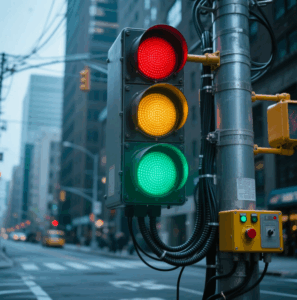
From Mechanical to Digital Control
Earlys relied on mechanical switches and clock-based systems. These timers could only operate on fixed intervals, meaning every cycle repeated identically, regardless of changing traffic volumes. Today, digital microprocessors and programmable logic controllers (PLCs) have replaced these mechanical systems.They allow engineers to configure multiple timing patterns and adjust them remotely. This digital foundation enables far more flexibility, accuracy, and responsiveness, which are essential for modern urban mobility.Sensor Integration and Real-Time Detection
Modern traffic signal timers are connected to a wide range of sensors that collect data from the road in real time.- Inductive loop sensors detect vehicles by sensing changes in electromagnetic fields under the road surface.
- Infrared or radar sensors monitor vehicle speed and density.
- Cameras can identify queue lengths, pedestrian movements, and even special vehicle types like buses or emergency vehicles.
Adaptive Algorithms and Artificial Intelligence
One of the most revolutionary developments in traffic signal timer technology is the use of adaptive algorithms. Artificial intelligence can analyze data continuously and optimize signal cycles to reduce congestion.For instance, if sensors detect heavy buildup in one direction, the algorithm automatically extends green time to relieve the queue. Machine learning models can also predict future congestion patterns based on historical data, allowing the system to act preemptively rather than reactively.This constant learning process makes traffic networks more efficient and less prone to manual errors.Wireless Communication and Centralized Control
Communication technology has transformed how traffic signal timers operate. Instead of functioning independently, timers now form part of an interconnected network controlled from a central operations center.Through wireless or fiber-optic connections, city traffic engineers can monitor all intersections in real time, adjust timing schedules, or diagnose faults remotely. This connectivity also allows for coordination between intersections, creating synchronized “green waves” that reduce start-stop driving and fuel consumption.Energy Efficiency and Sustainability
While technology has advanced timing precision, it has also made systems more energy-efficient.- Modern traffic signal timers work seamlessly with LED lighting, which consumes less power than traditional bulbs.
- Timers are also programmed to optimize idle times, reducing unnecessary fuel waste from vehicles waiting at red lights.