In modern industrial and commercial flooring systems, coating failures are one of the most costly and frustrating problems. Issues such as bubbling, peeling, delamination, and blistering often appear even when high-quality coatings are used. One of the most common hidden causes behind these failures is moisture vapor rising from concrete slabs. This is where moisture vapor barrier epoxy becomes an important solution. It is designed to block or significantly reduce moisture transmission from the substrate, helping floor coatings maintain long-term adhesion and performance. But can it truly prevent floor coating failures? The answer depends on how it is used, the environment, and the installation quality.
What Causes Floor Coating Failures?
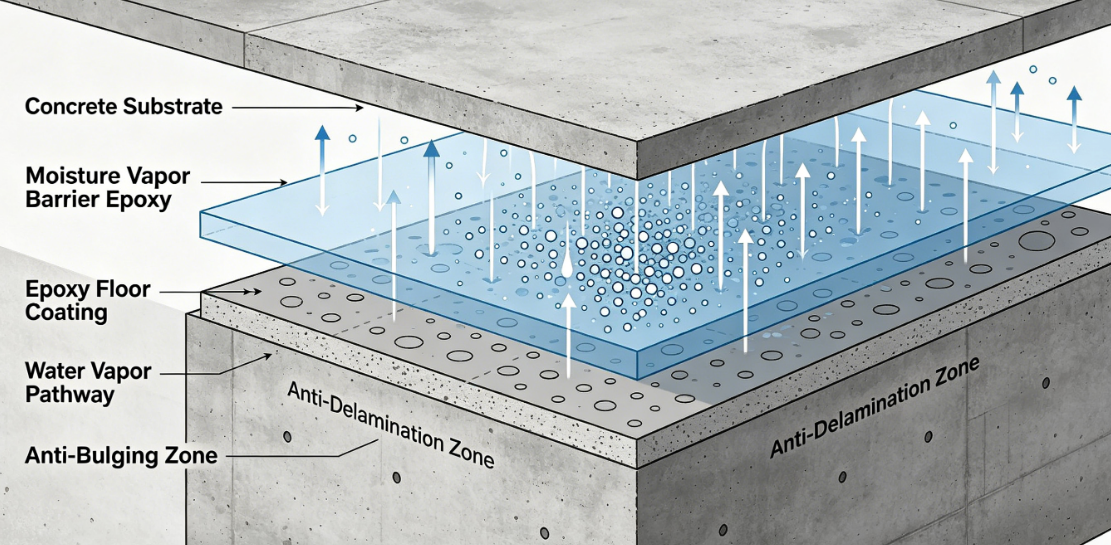
Floor coating failures rarely happen without underlying reasons. Understanding these causes helps explain why moisture vapor barrier epoxy is often required in demanding environments.- Moisture vapor pressure from concrete slabs: Even after concrete looks dry on the surface, internal moisture continues to rise upward. This vapor pressure can push against coatings, causing bubbling and blistering over time.
- Poor surface preparation before coating application: If the concrete is not properly cleaned, ground, or profiled, coatings cannot bond effectively. Dust, oil, or laitance weakens adhesion and increases failure risk.
- Thermal expansion and environmental changes: Temperature and humidity fluctuations cause the concrete and coating layers to expand and contract differently, leading to cracking or peeling.
- Use of incompatible coating systems: Some coatings are not designed to handle high moisture conditions. When applied in unsuitable environments, failure becomes almost inevitable.
How Moisture Vapor Barrier Epoxy Works
The main role of the moisture vapor barrier epoxy is to control moisture movement from concrete into the coating system. It acts as a protective intermediate layer.- Forms a dense, impermeable barrier layer: Once cured, the epoxy creates a tight molecular structure that reduces or blocks moisture vapor transmission from the substrate.
- Improves adhesion between concrete and topcoat systems: It enhances bonding strength by stabilizing the surface, allowing subsequent coatings to adhere more effectively and evenly.
- Reduces risk of osmotic blistering and delamination: By controlling vapor pressure beneath the coating, it prevents the formation of bubbles and separation layers.
- Supports long-term durability in high-moisture environments: Ideal for basements, warehouses, parking structures, and industrial facilities where moisture exposure is constant.
Can It Truly Prevent Floor Coating Failures?
While moisture vapor barrier epoxy significantly reduces the risk of failure, its effectiveness depends on proper system design and application.- Effective when moisture levels are within product limits: Most epoxy systems have specific moisture tolerance thresholds. If concrete moisture exceeds these limits, performance may still be compromised.
- Works best as part of a complete flooring system: It should be combined with proper primers, coatings, and surface preparation rather than used alone as a quick fix.
- Installation quality directly affects performance: Incorrect mixing ratios, uneven application, or insufficient curing time can weaken the barrier function.
- Not a substitute for structural moisture issues: If there are drainage problems or constant water intrusion, epoxy alone cannot fully solve the problem.
Best Practices for Using Moisture Vapor Barrier Epoxy
To maximize performance and truly prevent coating failures, proper application methods are essential.- Conduct moisture testing before installation: Use calcium chloride tests or RH probes to determine concrete moisture levels before selecting the epoxy system.
- Prepare the surface through mechanical grinding or shot blasting: A properly profiled surface ensures stronger bonding between concrete and epoxy layers.
- Apply under controlled environmental conditions: Temperature and humidity should be within manufacturer recommendations to ensure proper curing and adhesion.
- Follow correct mixing and application procedures strictly: Accurate mixing ratios and even spreading help avoid weak spots in the barrier layer.
- Allow sufficient curing time before topcoating: Rushing the process can trap moisture and reduce the effectiveness of the barrier system.