As people become more interested in sustainable living, garden design is evolving accordingly. In the case of garden design, beauty does not necessarily mean lots of concrete surfaces, plastic decorations, and flowers that will need regular replacement. Growing bamboo is an option that will give you the possibility to include some plants in your garden while still keeping its natural aspect.
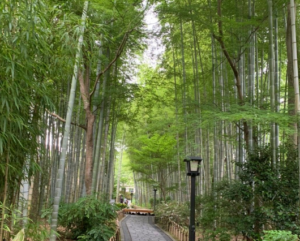
Bamboo grows quite fast and has distinctive features due to its tall stems and light leaves, which sway in the breeze, therefore providing a nice feeling of relaxation. Bamboo can also serve practical purposes when growing in your garden, as you may use it for privacy, creating divisions within your garden, and also giving additional height to your scenery. Nevertheless, growing bamboo sustainably is more complicated than it might seem at the very beginning, as there are various types of bamboo with different features.
Why Is Bamboo a Good Plant to Grow in Sustainable Gardens?
One more feature of bamboo that is important for sustainable gardening is the high rate of its growth. There are some types of bamboo that can grow much faster than any other common trees. As a result, bamboo is quite handy when one needs to increase the vegetation within a short time frame.
Another important property of bamboo is that it has firm roots and rhizomes. If it is grown in the right place, then this particular bamboo could be beneficial for soil fixation and water runoff prevention. In addition, bamboo has been analyzed for its role in carbon fixation and soil preservation. Nevertheless, all the positive impacts that bamboo makes on the environment are highly dependent on its particular species and conditions of growth.
Another advantage of bamboo is its verticality. When there is not enough space horizontally, one can get some verticality and greenery from bamboo.
| Bamboo Feature |
Possible Garden Benefit |
| Fast growth |
Creates greenery in less time |
| Tall, upright form |
Adds height without using much ground space |
| Dense foliage |
Provides a natural privacy screen |
| Strong root system |
Can help hold soil in suitable conditions |
| Natural appearance |
Works well with stone, wood, and other plants |
Where Can Bamboo Be Used in Garden Design?
It does not have to cover the whole garden for you to see a difference in its appearance. You only require a few well-placed plants in order to completely transform the look of your garden without overcomplicating its appearance.
A privacy area is one of the best uses for bamboo plants. This plant can provide a great screen that will separate your backyard from the rest of the properties, thereby creating a more private environment without adding too many structures such as fences.
You can also use bamboo plants at your garden entrances. Bamboo plants that grow vertically can create a perfect boundary between your entrance and the outside garden as you move from the house to the garden.
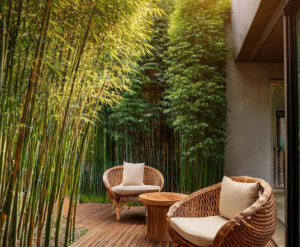
Lastly, patio and seating areas are ideal places to place bamboo plants. They will offer you a relaxing green background for your terrace or garden while you are out of the hustle and bustle of all that traffic.
Bamboo could also be combined with stone pathways, wood elements, gravel, and water installations. They all have the same natural design, so they could make a cohesive garden without any decorations.
How Should You Take Care of Bamboo in an Environmentally Friendly Garden?
Even an eco-friendly garden requires maintenance. Plants that are healthy usually need fewer replacements, and good maintenance can help avoid the bamboo’s spread where it is not welcome.
One needs to consider the climatic conditions prevailing in the area where bamboo plants will be planted. One needs to look at the temperatures, amount of rainfall, the amount of sunlight, and also the drainage of the soil. Even though bamboo plants require moisture, too much moisture might cause some challenges for these plants.
Here are some tips to help you care for bamboo plants:
- Select the appropriate species of bamboo: Select the appropriate species depending on the climate in your area and the size of the garden.
- The soil needs to be well moistened: The plant needs to be watered frequently, but the roots need to be kept dry.
- Trim off the dead stems: This will help keep the area where you plant clean and orderly.
- Do not use too much fertilizer: Too much fertilizer is unnecessary for the successful planting of bamboo and can have a negative impact on the soil in which it grows.
- Take control of the planting area: Find out if the type of bamboo you are planning to plant is a clumper or a runner before you plant.
- Deserves special mention: Running bamboo has the tendency to spread out into areas where it was not planted initially due to its rhizome structure. It will be harder to control in a residential garden with limited space.
How Can Bamboo Make a Garden More Natural?
It would be wiser to take into account the application of bamboo along with the use of other components of the natural environment, since the tall stems of bamboo can serve as the top layer of planting, while shrubs, grasses, flowers, and other plants for the ground cover will occupy the places below.
In more detail, tall bamboo can serve as the background of planting in the garden; medium-height shrubs of medium height can be planted before the bamboo plants; finally, the edge of the garden can have low plants. In this way, one achieves a multi-layer composition that does not require any complicated elements.
It is essential to take into account the elements surrounding the bamboo plant as well. Therefore, such natural materials as stone, unpainted wood, gravel, and local plants may be used to create a single ensemble. In addition, it is necessary not to use numerous artificial decorations since it is possible to create a certain effect due to different textures – smooth stones, rough wood, and fine bamboo leaves.
In order to create an eco-friendly garden, one can proceed further and leave some parts of the garden informal. Thus, the fallen leaves may serve as a ground cover, while some soil may be left planted without covering it with concrete.
Conclusion
And why is it that bamboo is the ideal choice for garden design with sustainability in mind? The worth of this plant goes beyond the mere aesthetic aspect. It grows fast, gives vertical greenery, provides privacy, and possibly protects soil and supports carbon storage in appropriate conditions.
Proper planting is the answer to acquiring all the mentioned benefits. Selecting the right kind of bamboo suitable for the climate in which you live, controlling its spread, and planting other plants indigenous to the place will make your garden blend well and be easy to maintain.
Gardening sustainably is really very simple. With the right choice of bamboo, the right planting location, and some natural materials, an ordinary garden turns into an eco-friendly one.
0