As global urbanization accelerates, road traffic safety and smart management have become core components of city development. In this context, conventional traffic lights based on incandescent technology will continue to become obsolete, giving way to highly efficient and power-saving
LED traffic signal lights. For urban planners, engineering contractors, and buyers of traffic equipment, it is important to have an idea of the mainstream classification of these lamps. This article breaks down the three mainstream types of LED traffic signal lights and explores their technical characteristics and application scenarios.
1. Ball / Module LED Traffic Signal Lights
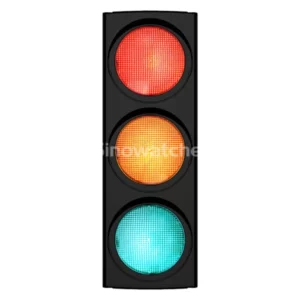
Ball or module-style LED traffic signal lights serve as the standard, foundational configuration on urban roads. These lights generally have a round shape (with a common diameter of either 200mm or 300mm) with the inner portion containing many dozens or hundreds of highly luminous LEDs in a grid formation.
Their technical merits shine through in several areas:
- Outstanding Performance: High-quality optical lenses make sure that there is even light dispersion, ensuring that drivers can see all red, yellow, and green statuses even under glaring sunlight or foggy conditions.
- Durable Use Time: High-quality ball modules commonly used in the industry generally last more than 80,000 hours before having to be replaced again, significantly minimizing such replacements for city administrations.
- Great Environmental Durability: The circuit inside has a wide temperature range and operates successfully within the extremes of -40°C to +80°C, thus being well-suited for common urban intersections.
2. Arrow / Patterned LED Traffic Signal Lights
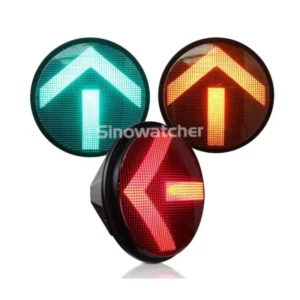
Arrow-type or pattern-based LED traffic signal lights are mainly used at complicated intersections having more than one phase, dedicated turn lanes, and ramp accesses for highways. Unlike conventional circular signal lights, these signal lights have accurate optical lenses and specific visors that direct arrows pointing towards either left, right, forward, or even for U-turns.
In practical engineering applications, these fixtures offer distinct highlights:
- Elimination of Visual Ambiguity: Highly directional designs drastically cut lane confusion rates, effectively lowering traffic conflict and accident rates.
- Anti-Phantom and Robust Housing: Premium arrow modules often utilize anti-UV polycarbonate shells with exceptional impact resistance and anti-phantom effects, preventing misleading signals even under direct backlight.
- International Quality Standards: During project procurement, many contractors choose solutions like theSinowatcher-300mm high-flux arrow module, which holds strict EN12368 European certifications to guarantee reliability in harsh road conditions.
3. Intelligent Control of LED Traffic Signal Lights
With the proliferation of smart cities, LED traffic signal lights integrated with digital countdown modules and intelligent control technologies are capturing the market. These devices combine traditional color displays with dynamic countdown timers, showing drivers and pedestrians the exact remaining seconds in real time.
Their core value in modern traffic management includes:
- Anxiety Reduction: The digital time displays significantly relieve stress for drivers while at intersections, reducing the number of rear-end accidents caused by impatiently running yellow signals or leaving too soon.
- Linking to Intelligent Systems: Recent technological advancements make it possible for intelligent transportation systems (ITS) to connect to these signal lights in terms of traffic sensors and control centers.
- Traffic Flow Enhancement: The dynamic digital displays combined with the efficient LED-emitting units create a quantum jump in the efficiency of traffic flow on arterial routes and pedestrian-heavy locations.
4. Comparison & Selection Guide
To help project procurement teams make optimal decisions, the core parameters and application scenarios of the three main types of LED traffic signal lights are compared below:
| Light Type |
Core Advantages |
Typical Application Scenarios |
Maintenance & Lifespan |
| Ball / Module |
Classic structure, uniform light, low retrofit cost |
Standard intersections, conventional streets |
Lifespan over 80,000 hours, strong temperature adaptability |
| Arrow / Patterned |
High directionality, anti-phantom, reduces lane conflict |
Dedicated turning lanes, complex multi-phase junctions |
Uses anti-UV polycarbonate, high impact resistance |
| Countdown & Smart |
Eases anxiety, supports IoT linkage |
High-density pedestrian zones, main arterials, smart traffic projects |
Boosts traffic flow, reduces rear-end accidents |
In choosing appropriate traffic equipment, consumers must consider the amount of traffic in their area, the complexity of lanes, and any municipal requirements (for example, certification according to CE, RoHS, or EN12368). For instance,
Sinowatcher—a leading global manufacturer of traffic safety equipment—leverages its deep technical expertise to provide high-quality traffic safety solutions to over 80 countries worldwide.
5. Conclusion
To summarize, ball modules, arrow modules, and smart countdowns constitute the three key components of contemporary traffic systems. All of them are indispensable for securing traffic safety and reducing energy use. With the advancement of optoelectronics technologies, LED traffic signal lights of the future will be smarter and more personalized. City administrators must learn how to operate these highly sophisticated LED traffic signal lights in order to build safe, efficient, and environmentally friendly smart cities.
0