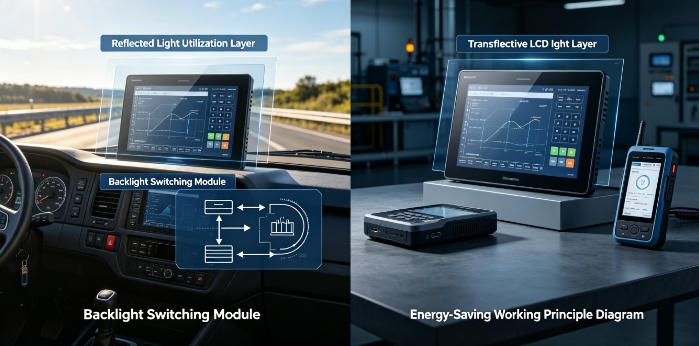
The transflective LCD is a specialized display technology designed to deliver clear visibility in both bright and low-light environments. Unlike conventional LCD screens that rely almost entirely on backlighting, this technology combines reflective and transmissive display principles to adapt to changing lighting conditions. In bright sunlight, it uses ambient light to improve readability, while in darker environments it switches to backlight support for stable image quality. Because of this flexible performance, the transflective LCD has become increasingly popular in industrial equipment, transportation systems, portable electronics, and outdoor devices. Its ability to balance visibility, power efficiency, and durability gives it several advantages over traditional display technologies. Understanding these benefits helps explain why it remains an important solution for demanding applications.
Superior Visibility in Bright Outdoor Environments
One of the biggest advantages of a transflective LCD is its ability to remain highly readable under direct sunlight, where many traditional displays struggle.- Uses ambient light effectively: Instead of being negatively affected by sunlight, the screen reflects natural light to improve visibility.
- Reduced washed-out appearance: Traditional LCDs often lose contrast outdoors, while this technology maintains sharper images and text.
- Improved viewing comfort: Operators and users can read the screen more easily without constantly adjusting viewing angles.
- Cross-Environment Performance Consistency: The display maintains stable readability regardless of whether it is in bright daylight or a semi-shaded environment.
Enhanced Energy Efficiency and Lower Power Consumption
Energy efficiency is another major advantage that makes this technology attractive for battery-powered and portable devices.Key power-saving benefits include:
- Reduced backlight dependence In bright environments, the display primarily uses reflected ambient light instead of relying heavily on its internal backlight.
- Longer battery life Portable devices such as GPS systems and handheld scanners can operate for extended periods without frequent charging.
- Lower heat generation Reduced backlight usage decreases internal heat buildup, improving overall device stability.
- Efficient daytime operation Outdoor devices can remain visible while consuming significantly less power compared to standard LCDs.
Strong Adaptability Across Different Industries
The flexibility of this display technology allows it to be used across a wide range of industries and application scenarios.- Industrial equipment: Construction machinery and factory control systems benefit from clear readability under harsh lighting conditions.
- Transportation systems: Vehicle dashboards, marine navigation devices, and railway systems require stable visibility in changing environments.
- Medical and emergency tools: Portable diagnostic equipment needs dependable displays in both indoor and outdoor situations.
- Military and field devices: Tactical equipment benefits from durable visibility and lower energy consumption during operations.
Improved Durability and Reliability in Harsh Conditions
Many outdoor and industrial environments expose displays to difficult operating conditions, and this technology is designed to handle those challenges effectively.- Better resistance to temperature variation: The display can function under both hot sunlight and cooler nighttime conditions.
- Compatibility with rugged designs: It is often integrated into equipment designed for dust resistance, vibration protection, and outdoor durability.
- Stable readability during long use periods: Continuous exposure to outdoor lighting has less impact on visibility performance.
- Reduced operator strain: Clear displays help reduce eye fatigue for workers who rely on screens for extended periods.
Balanced Indoor and Outdoor Performance
Unlike displays optimized only for indoor use, this technology performs effectively across multiple lighting conditions.- Automatic Adaptability: Capable of seamlessly switching between a visible state under direct sunlight and a backlight-assisted operational state indoors.
- Reliable contrast levels: The display maintains readable content regardless of environmental brightness changes.
- Reduced need for brightness adjustment: Users do not need to constantly modify screen settings when moving between environments.
- Practical versatility: Devices equipped with this display type can be used indoors, outdoors, and in semi-outdoor environments without major performance loss.