In the world of food production, consistency is king. Whether it's the smooth pour of a salad dressing, the creamy mouthfeel of a dairy alternative, or the perfect crumb in gluten-free bread, achieving the right texture requires precision. One ingredient has emerged as an indispensable tool for food manufacturers worldwide: xanthan gum thickener.
At Neofoods, we supply high-quality xanthan gum that helps food producers achieve consistent results across thousands of applications. This naturally derived polysaccharide offers unparalleled versatility, stability, and efficiency—often at concentrations as low as 0.1%.
What Is Xanthan Gum?
Xanthan gum is a naturally derived polysaccharide produced through the fermentation of sugars by the bacterium Xanthomonas campestris. This same bacterium is responsible for the black rot found on cruciferous vegetables like cabbage and cauliflower—but through controlled fermentation, it becomes the source of one of food science's most valuable ingredients.
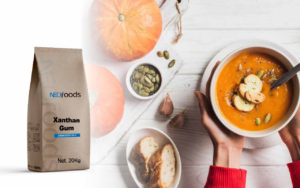
The fermentation process yields a substance that is then precipitated, dried, and ground into a fine, cream-colored powder. When this powder is hydrated, it forms a highly effective thickening and stabilizing agent with unique properties:
- Creates viscosity at very low concentrations (0.1–0.5%)
- Works in both hot and cold liquids
- Remains stable across a wide pH range (typically 2–12)
- Withstands high temperatures and freeze-thaw cycles
- Provides consistent results batch after batch
Key Functional Properties
- Exceptional Thickening Power
Xanthan gum is one of the most efficient thickeners available. At concentrations as low as 0.1–0.5%, it can significantly increase the viscosity of aqueous systems. This efficiency translates to cost savings and cleaner formulations for manufacturers.
- Pseudoplastic Behavior
Xanthan gum solutions are pseudoplastic—they thin under shear stress and recover viscosity when at rest. This means:
- During mixing and pumping: Low viscosity, easy processing
- In the bottle or package: High viscosity, stable suspension
- During consumption: Smooth mouthfeel without gumminess
- Temperature and pH Stability
Unlike many hydrocolloids, xanthan gum maintains its viscosity across a broad temperature range and at pH levels from 2 to 12. This makes it suitable for:
- High-temperature processing (UHT, retort)
- Acidic systems (salad dressings, fruit preparations)
- Frozen applications (ice cream, frozen desserts)
- Synergy with Other Gums
Xanthan gum exhibits remarkable synergy with galactomannans like guar gum and locust bean gum. These combinations can create enhanced viscosity or gel structures, allowing manufacturers to fine-tune texture economically.
Technical Specifications at a Glance
| Parameter |
Specification |
Significance |
| Appearance |
White to cream-colored powder |
Clean, consistent visual quality |
| Viscosity |
1200–1600 mPa·s (1% in 1% KCl) |
Guarantees consistent thickening performance |
| Assay (dry basis) |
91.0–108.0% |
High purity, reliable functionality |
| Loss on Drying |
6.0–12.0% |
Stable shelf life |
| pH (1% solution) |
6.0–8.0 |
Neutral, compatible with most systems |
| Particle Size |
80 mesh: 100% min; 200 mesh: 92% min |
Consistent dispersion and hydration |
| Heavy Metals |
≤ 20 mg/kg (as Pb) |
Meets global food safety standards |
| Microbiology |
TPC ≤ 2000/g; Pathogens negative |
Safe for direct food use |
Applications Across the Food Industry
Xanthan gum's versatility makes it valuable across virtually every food category. Here are the most common applications:
Salad Dressings and Sauces
Xanthan gum is the gold standard for emulsified dressings. It:
- Prevents oil-water separation through stable emulsion formation
- Provides consistent pouring viscosity
- Suspends herbs and spices evenly throughout the product
- Delivers clean flavor release without masking other ingredients
Typical usage: 0.1–0.3%
Dairy and Frozen Desserts
In ice cream and frozen yogurt, xanthan gum:
- Controls ice crystal growth during freezing and storage
- Improves freeze-thaw stability
- Provides creamy mouthfeel in low-fat formulations
- Works synergistically with guar gum and locust bean gum
Typical usage: 0.1–0.2%
Gluten-Free Baking
For manufacturers of gluten-free products, xanthan gum is essential:
- Mimics the elasticity and structure normally provided by gluten
- Improves dough handling properties
- Enhances volume and crumb structure
- Prevents crumbling in finished baked goods
Typical usage: 0.5–1.0% (based on flour weight)
Beverages
In both alcoholic and non-alcoholic beverages, xanthan gum:
- Suspends pulp and fruit particles
- Provides body and mouthfeel in reduced-calorie drinks
- Stabilizes emulsions in coffee whiteners and creamers
- Improves texture in plant-based milk alternatives
Typical usage: 0.05–0.2%
Noodles and Pasta
Xanthan gum improves processed noodle products by:
- Reducing stickiness during cooking
- Improving texture and bite
- Enhancing water retention
- Increasing yield
Meat and Meat Alternatives
In both traditional and plant-based meat products:
- Binds water for improved yield and juiciness
- Emulsifies fats in sausages and frankfurters
- Provides texture in meat analogs and substitutes
- Stabilizes brine solutions for injection
Confectionery
In candy manufacturing, xanthan gum:
- Prevents sugar crystallization
- Provides stable gel structures
- Improves texture in gummies and jellies
How to Use Xanthan Gum Effectively
Recommended Usage Levels
| Application |
Typical Usage (%) |
| Salad dressings |
0.1–0.3 |
| Sauces and gravies |
0.1–0.3 |
| Beverages |
0.05–0.2 |
| Ice cream |
0.1–0.2 |
| Gluten-free baking |
0.5–1.0 |
| Meat products |
0.1–0.3 |
| Dairy alternatives |
0.1–0.3 |
Best Practices for Incorporation
- Dry Blending Method
For best results, mix xanthan gum with other dry ingredients (sugar, flour, starch) before adding to liquids. This prevents the formation of lumps by separating the gum particles.
- Oil Dispersion Method
Xanthan gum can be dispersed in oil before addition to water-based systems. This is particularly useful for dressings and sauces.
- High-Shear Mixing
Once added to water, high-shear mixing accelerates hydration. Full viscosity develops within minutes.
- Pre-hydration in Glycerin
For difficult applications, xanthan gum can be pre-mixed with glycerin or other polyols to form a paste, then diluted with water for lump-free incorporation.
Why Xanthan Gum Is Essential for Clean-Label Products
As consumers demand simpler ingredient lists, xanthan gum offers a clean-label advantage:
- Naturally derived: Produced through fermentation, not chemical synthesis
- Recognizable name: Increasingly familiar to consumers
- Multifunctional: Replaces multiple additives (stabilizers, thickeners, emulsifiers)
- Low usage levels: Minimal impact on ingredient declarations
The Neofoods Advantage
At Neofoods, we understand that ingredient quality directly impacts your final product. Our xanthan gum offers:
- Consistent Quality: Every shipment meets our stringent specifications, verified through comprehensive testing
- Food-Grade Compliance: Full adherence to international food safety standards
- Technical Support: Our team helps you optimize formulations for your specific applications
- Reliable Supply: Robust sourcing ensures production continuity
- Custom Solutions: Particle size and packaging options available
Beyond Food: Additional Applications
While this article focuses on food applications, xanthan gum's utility extends to:
- Cosmetics and personal care: Stabilizes creams, lotions, and gels
- Pharmaceuticals: Suspends active ingredients in liquids
- Industrial applications: Used in paints, adhesives, and drilling fluids
Conclusion
Xanthan gum stands as one of the most versatile and reliable ingredients available to food manufacturers. Its ability to thicken, stabilize, and enhance texture across a remarkable range of applications—from salad dressings to gluten-free bread, from ice cream to plant-based milks—makes it an essential tool for product development and quality assurance.
Partner with Neofoods for your xanthan gum needs. We provide the quality, consistency, and technical expertise to help you create products that stand out in today's competitive market.
0