The
automatic liquid filling machine fills liquids into the containers based on the desired amount or fill level. The selection of the right filling mechanism is based on the viscosity, foamability, chemicals, and type of containers. There is no single filling mechanism for all products. Therefore, it is important to learn about filling mechanisms first.
1. Understanding How an Automatic Liquid Filling Machine Works
1.1 The Basic Filling Process
Most filling machines undergo a number of basic stages that include the following:
• Product Feeding: The product is taken out from the storage tank and introduced to the filling machine.
• Container Feeding: Bottles are introduced to the machine and positioned under the filling spouts.
• Metering: The amount of product needed is determined using a pump, piston stroke, or other metering process.
• Filling: Product is dispensed into the bottles.
• Product Output: Filled bottles are fed to the next station for processing.
1.2 Main Components
A typical automatic filling machine will comprise a product feed system, filling heads, a conveyor for holding containers, sensors, and control panels. Other accessories that can be used, depending on the type of filling, include pumps, measuring cylinders, flow meters, and vacuum systems.
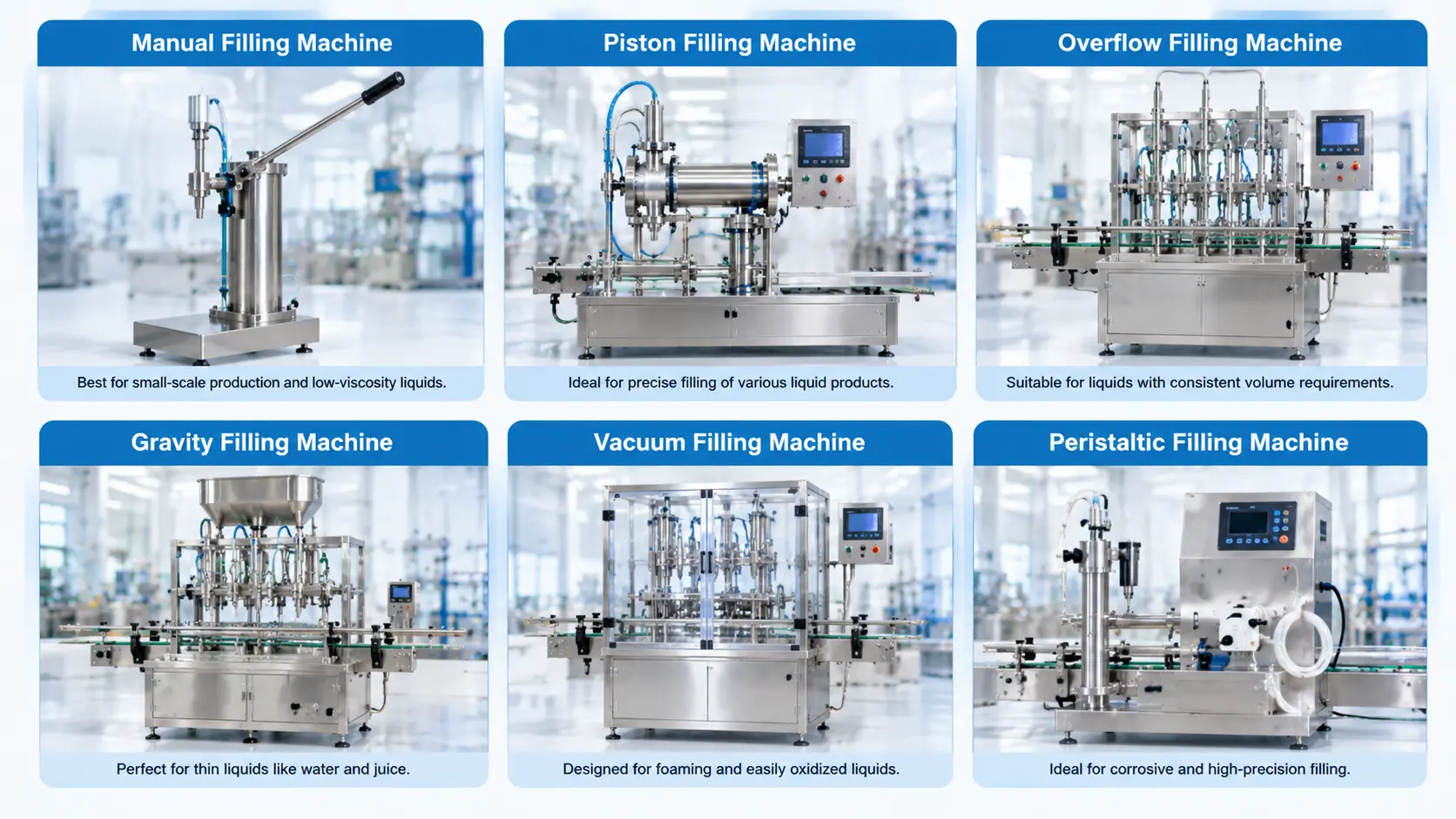
2. Main Types of Automatic Liquid Filling Machines and Their Applications
For a comparison of the liquid filler to other types of machines, begin with the product and packaging before moving on to the number of filling heads. The following sections discuss the types of automatic liquid filling machines along with specific configurations. There may be some overlap among the various categories, such as in a chemical filling machine.
2.1 Piston Filling Machines
The product is filled with a piston, which draws it into a measuring chamber and then pushes it out with a piston stroke. The piston fillers are usually applied to products that have medium and high viscosity, including products like liquid soap, lotion, syrup, and other similar ones, provided that the valves and nozzles are suitable for such products. An example is the ZS-YT2T-2PXD Automatic 2 Heads Servo Piston Pump Liquid Soap Filling Machine.
2.2 Peristaltic Pump Filling Machines
In a peristaltic automatic liquid filling machine, the rotating wheels squeeze a soft tube, causing the fluid to travel from the tube towards the filling nozzle. In the pump, the fluid comes into contact with the tube, not the pumping device. This type of machine is ideal for some low-viscosity fluids and situations where changeover may be simplified by switching out the product contact tube.
2.3 Vacuum Filling Machines
The filling machine operates under the principle of differential pressure, which enables the filling of bottles with liquids. This process may enable the filling of perfumes and the selection of bottles based on their suitable sealing properties. However, it is very important to ensure that there is knowledge about the bottle and the fluid before applying the process. The ZS-YTZL4A Automatic 4 Heads Vacuum Perfume Bottle Filling Machine is specifically made for filling perfume bottles using the four-head vacuum filling process.
2.4 Overflow Filling Machines
It is essential for the liquid level in overflow filling machines because there is a need to achieve an equivalent level of visibility of the liquid being filled. Once the required liquid level is achieved, the rest of the liquid flows back through the return path.
One such machine is the Automatic Distilled Liquor Liquid Overflow Filling Machine.
2.5 Chemical Liquid Filling Machines
A filling machine for chemicals should be chosen considering the chemical nature of the fluid in question, its chemical composition, viscosity, volatility, and corrosive properties. The wetted parts, such as piping, valves, seals, and nozzles, should be compatible with the chemicals. In case of flammable liquids, the machine should be chosen based on the classification of the hazardous area where it will be installed.
2.6 Servo Paste Filling Machines
The servo paste filling machines employ motor-driven metering systems because the viscous nature of such products requires precise dispensing. These types of machines are used for dispensing products such as cosmetic cream, cleansing balm, and sunscreen lotions. In some cases, temperature control or mixing might be needed due to the nature of the products.
The ZS-VTGTL2 Servo Automatic Cleansing Balm Sunscreen Stick Filling Machine is an example of such equipment.
Conclusion
The perfect automatic liquid filling machine should suit the properties of the fluid, the specifications of the container, and the working environment. Most viscous fluids require piston filling machines, while the peristaltic filler makes provision for pumping the fluids through the tubing. The vacuum and overflow filling machines can be used in some containers. Testing is very important before purchase.
0