In modern industries, automation has become a key factor in improving production efficiency, reducing costs, and ensuring product quality. As technology advances, traditional industrial robotic arms often struggle to meet the demands of complex and diversified production tasks. At this point, the 5-axis anthropomorphic robot stands out with its flexibility, high precision, and multifunctional capabilities, playing an essential role in industrial automation. So, how can a 5-axis anthropomorphic robot effectively improve industrial automation processes and enhance overall production efficiency?

What is a 5-axis anthropomorphic robot?
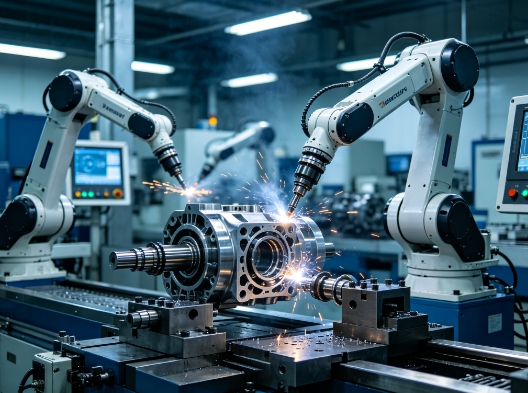
A 5-axis anthropomorphic robot is a high-performance industrial robot designed to mimic the movements of a human arm. It typically features five degrees of freedom, including rotational, bending, and telescopic motions, allowing it to perform complex operations in three-dimensional space. Compared to traditional robotic arms, the five-axis design gives the robot greater flexibility in tasks such as assembly, material handling, welding, painting, and precision machining. Its humanoid arm structure also allows more natural interaction with production lines, tools, and workpieces, improving work efficiency and operational safety. In addition, as a high speed robotic arm, it can perform repetitive tasks quickly without compromising accuracy, making it ideal for high-throughput industrial applications.
Advantages of 5-axis anthropomorphic robots in industrial automation
-
High Precision and Flexibility
-
Enhanced Production Efficiency
-
Reduced Production Costs
-
Adaptability to Diverse Production Needs
Application Scenarios of 5-axis anthropomorphic robot
-
Automotive Manufacturing
-
Electronics Manufacturing
-
Food and Pharmaceutical Industries
-
Scientific Research and Laboratories