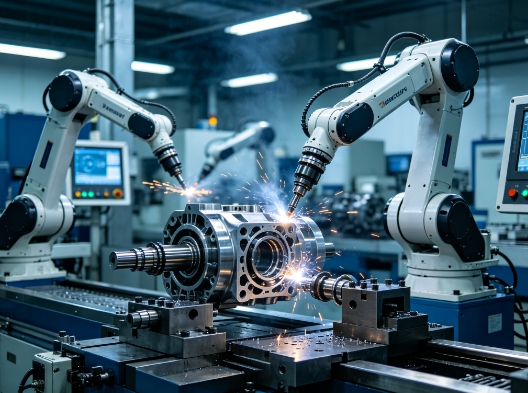
In modern industrial environments, automation has become a critical factor for improving productivity, consistency, and cost efficiency. As manufacturing processes become more complex, traditional equipment often struggles to meet the demands of high-precision and multi-step operations. The 5 axis robot arm has emerged as a powerful solution that addresses these challenges by offering advanced motion flexibility and intelligent control. With its ability to operate across multiple axes simultaneously, it is widely used in industries such as automotive, aerospace, electronics, and precision engineering, where accuracy and efficiency are essential.
Multi-Axis Flexibility for Complex Industrial Tasks
One of the most important advantages of the 5 axis robot arm is its ability to perform highly flexible movements, making it suitable for complex industrial operations that require multiple angles and orientations.- It can rotate and move across several axes at the same time, allowing it to reach positions that are difficult or impossible for traditional robotic systems.
- This flexibility reduces the need for manual repositioning of materials, which helps maintain alignment accuracy during machining or assembly.
- In applications such as welding or cutting, the robot can maintain optimal tool orientation throughout the entire process, improving operational precision.
- It is especially effective for handling irregular or curved components that require continuous angle adjustments during processing.
Improved Precision and Consistent Output Quality
Precision is a critical requirement in industrial manufacturing, and the 5 axis robot arm significantly enhances accuracy and repeatability across production processes.- It delivers consistent movement patterns, ensuring that each production cycle produces identical results.
- High-resolution control systems allow for extremely fine adjustments in positioning, reducing errors in machining and assembly tasks.
- Integrated sensors help monitor and correct deviations in real time, maintaining stable output quality.
- It reduces human-induced variations, which are often a major source of inconsistency in manual production environments.
Increased Efficiency in Production Workflows
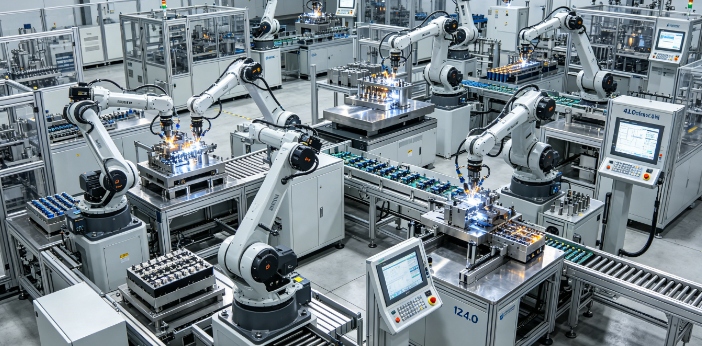
Another major advantage of the 5 axis robot arm is its ability to improve overall production efficiency by streamlining workflows and reducing unnecessary operational steps.- It performs multiple tasks in a single setup, eliminating the need for repeated repositioning of workpieces.
- Automated motion control reduces idle time between production stages, allowing smoother workflow transitions.
- High-speed operation capability increases output without sacrificing accuracy or stability.
- Optimized path planning reduces unnecessary movement, improving cycle time efficiency.
Reduced Operational Costs and Resource Consumption
The 5 axis robot arm also contributes to lowering long-term industrial costs by improving resource utilization and reducing waste.- Automation reduces dependency on manual labor, lowering workforce-related expenses.
- Precise machining and handling reduce material waste caused by errors or defects.
- Energy-efficient operation helps minimize electricity consumption in continuous production environments.
- Fewer production errors result in lower rework and maintenance costs over time.
Strong Adaptability Across Multiple Industries
The versatility of the 5 axis robot arm allows it to be used in a wide range of industrial sectors with different production requirements.- In automotive manufacturing, it is used for welding, assembly, and precision component machining.
- In aerospace industries, it supports high-precision processing of complex structural parts.
- In electronics manufacturing, it enables accurate placement and handling of micro-scale components.
- In medical device production, it ensures clean, precise, and controlled manufacturing processes.