Share:

In today’s display industry, every experienced reflective lcd manufacturer aims to produce screens that are clear, efficient, and reliable. Among many display types, reflective LCDs and transflective LCDs are two important categories. Both use ambient light to some degree, but they differ in structure, performance, and application. Understanding these differences helps users and engineers make smarter choices for different environments. reflective lcd manufacturer

I. What Is a Reflective LCD?

  • How It Works
A reflective lcd manufacturer designs this display to reflect light rather than emit it. Behind the liquid crystal layer is a reflective mirror that bounces incoming light back to the viewer. The brighter the light, the clearer the image appears. Because it doesn’t need a backlight, a reflective LCD uses very little power—typically less than 0.5 watts per square meter.
  • Key Feature
Reflective LCDs are most effective outdoors or under strong lighting. Tests show they can maintain a contrast ratio above 12:1 under 100,000 lux of sunlight. The image remains sharp without glare or heat buildup. However, in dim or dark settings, the display becomes hard to read unless an external light source is used.
  • Advantages
Many reflective lcd manufacturers highlight their low energy use and eye comfort. They consume up to 90% less power than transmissive LCDs, making them ideal for portable or solar-powered devices. Because they use reflected light, they also reduce eye fatigue and perform best in natural conditions.

II. What Is a Transflective LCD?

  • Dual Working Mode
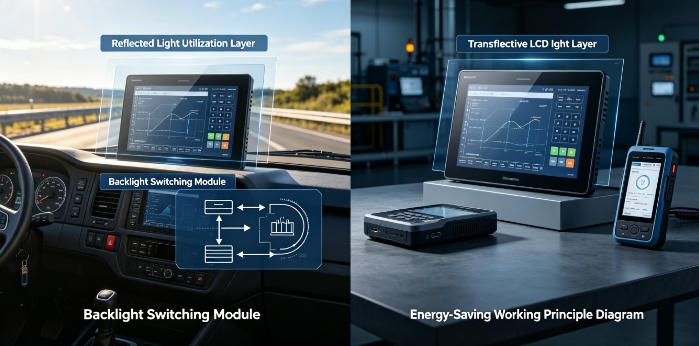
A reflective lcd manufacturer also produces transflective displays that combine both reflective and transmissive features. A semi-transparent layer allows part of the light to pass through and part to reflect. This means the screen can be visible both in daylight and at night with a backlight.
  • Balanced Performance
Transflective LCDs typically consume around 1.5–2 watts per square meter, slightly higher than reflective ones but much lower than full-backlit models. They are commonly used in car dashboards, aviation panels, and outdoor monitors. In daylight, they reflect light efficiently; in darkness, the built-in backlight ensures visibility.
  • Main Benefits
According to most reflective lcd manufacturers, transflective displays are the best choice when lighting conditions change frequently. Their typical brightness can reach 600 nits under backlight, ensuring visibility in both indoor and outdoor use. They offer an excellent balance between clarity and energy use.

III. Main Differences Between Reflective and Transflective LCDs

  • Dependence on Light
A reflective lcd manufacturer will explain that reflective screens rely entirely on external light, while transflective ones can generate light through an internal source. This difference determines their performance—reflective LCDs excel under sunlight, while transflective LCDs handle both bright and dark environments.
  • Power Consumption
Reflective displays are far more energy-efficient. They draw power only when updating pixels, while transflective displays consume 20–30% more energy when the backlight is active. However, this trade-off offers better readability in dim conditions.
  • Visual Contrast
Tests from a leading reflective lcd manufacturer show that reflective LCDs reach a contrast ratio of 15:1 in sunlight. Transflective LCDs, on the other hand, average around 10:1 but maintain visibility at night. Thus, contrast depends strongly on lighting and design priorities.
  • Cost and Structure
Reflective LCDs have a simpler design, making them cost-effective. Transflective LCDs are more complex because they must balance reflection and transmission layers. This increases their cost by roughly 20–25%, depending on screen size and resolution. reflective lcd manufacturer

IV. Application Areas of Reflective and Transflective LCDs

  • Outdoor and Industrial Devices
Many reflective lcd manufacturers supply modules for GPS trackers, solar meters, and e-readers. These displays operate perfectly in sunlight and have a lifespan of over 50,000 hours. They are commonly used in handheld devices, measurement tools, and outdoor advertising screens.
  • Automotive and Aviation Equipment
Transflective LCDs dominate in environments with variable lighting. Car dashboards and cockpit displays must be readable both under direct sun and at night. A reflective lcd manufacturer may include automatic brightness adjustment to adapt instantly to external lighting changes.
  • Consumer Electronics
Reflective LCDs are used in smartwatches and fitness trackers because of their low power needs. Some smartwatches last up to 30 days per charge. Transflective LCDs appear in action cameras and outdoor smartphones, where both indoor and outdoor readability are essential.

V. Conclusion

Reflective and transflective LCDs serve different purposes, but both are essential innovations in modern display technology. A reflective lcd manufacturer focuses on visibility, energy efficiency, and long lifespan for outdoor or portable devices. Meanwhile, transflective LCDs meet the needs of users who require clear viewing across all lighting conditions. Reflective LCDs excel under sunlight and save energy, while transflective LCDs adapt to any brightness level with balanced performance. As technology improves, both types will continue to evolve—offering clearer visuals, greater flexibility, and greener solutions for the display industry.0

Featured Articles

TFT Display Module
Five Major Applications of TFT Display Module in Electronic Devices
5-axis anthropomorphic robot
How can a 5-axis anthropomorphic robot improve industrial automation?
fast connector3
How Do Fast Connectors Work with Fiber Optic Networks?
baseball sunglasses factory
Importance of Choosing the Right Baseball Sunglasses Factory
hjdiandongc
EV Charging Cable Guide
drop
What Is a Drop Fiber Optic Cable?