This is often described as a tree that is best suited to be grown in cooler climatic conditions, as the best results will be seen when there are cool summers and gradual seasonal changes. In warmer climates, people still go for this plant due to its graceful leaves and stunning fall colors. The problem with growing this tree in a warm climate is that of the summer heat, which will destroy the leaves of the tree quickly.
Growing this tree in a warm climate will not force the tree to bear the hot conditions; rather, it is all about finding the right place to grow this tree and reducing the heat-related stress on the tree.
What Climate Does Japanese Maple Prefer?
The plant thrives in places with a moderate climate and definite seasons. Cooler places usually produce more colorful foliage during the fall season since cooler weather is conducive to the change in color of the green leaves to red, orange, and gold.
Hotter climates can pose some challenges since they affect the leaves and the roots of the plant. If the temperatures are high for several days and the sunlight is very bright, the edges of the leaves can turn brown, a condition that is known as leaf scorch and is common for people growing this plant in hot weather.
Not all hot climatic conditions are hard for the plant. For example, a garden in a humid area with plenty of rain may offer a more favorable environment than a dry place with too much sun and low humidity.
| Climate |
Growing Difficulty |
Recommended Care |
| Mild summer areas |
Low |
Normal watering and pruning |
| Warm humid areas |
Medium |
Avoid excessive afternoon sunlight |
| Hot and dry areas |
Higher |
Provide shade and monitor soil moisture |
For gardeners living in warmer locations, the planting spot often determines success. A Japanese maple placed in the wrong area may struggle even with frequent watering, while a tree planted in a protected corner can grow for many years.
How to Protect Japanese Maple During Hot Summers?
The main threat to Japanese maple that comes with a warm climate is high temperatures during summers. Before growing this plant, choosing a proper place is essential.
It is advised to choose a location that has some sunlight in the morning and shade in the afternoon. For example, planting a tree on the eastern part of the house would guarantee enough light in the morning and the absence of much sunlight in the afternoon. In large gardens, other trees and structures could provide a tree with shade.
It is necessary to change your watering schedule during summer days. Japanese maples cannot stand dry soil, especially with regard to high temperatures. On the other hand, overwatering of the tree may become a problem.
One more step in summer gardening would be mulching around the trunk of the tree. The bark, compost, or dried leaves reduce evaporation and keep the roots of the tree cool. Additionally, mulching improves the soil by decomposing gradually.
It is also crucial to choose the right type of Japanese maple in hot areas. It would be better to use small varieties because they require less space and are less often under the influence of difficult weather conditions. Gardeners should not perform any pruning on hot summer days.
Where Does Japanese Maple Work Best in Landscape Design?
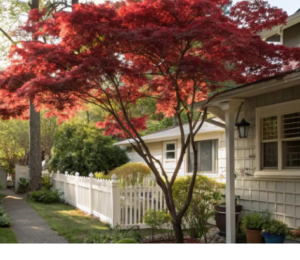
Japanese maple is a type of tree that can completely alter the mood of a garden, occupying only a small portion of the area. The delicate branches and the bright color of its leaves can attract attention at any time of the year, adding green accents in spring and summer, and becoming the main accent in the landscape during fall.
In Japanese-style gardens, this tree is often used around small stone paths, ponds, and wooden fences. Such elements of design emphasize the natural forms of the tree and do not overcrowd the garden with additional objects. Japanese maple can create an oasis where visitors can relax, walk, or just observe the changes of seasons.
In gardens with limited space, this tree is also a good choice. It can be planted in courtyards, used as a decoration for garden gates, or even grown in containers. With proper trimming, a Japanese maple grown in a pot will be able to preserve its compact form and add a piece of garden atmosphere to the garden.
In order to plant a Japanese maple in a garden in a warm climate, one should use other species that will match it well. Such vegetation, like shade plants, ornamental grasses, and low shrubs, will help form a multilayered landscape while at the same time keeping the soil moist enough. Such a planting scheme is advantageous in many aspects, including easy maintenance.
| Location |
Design Idea |
| Small courtyard |
Use Japanese maple as a focal plant |
| Patio |
Grow compact varieties in containers |
| Japanese garden |
Combine with rocks and water features |
| Modern garden |
Match with grasses and shrubs |
The best landscape designs usually avoid planting too many competing species. Giving Japanese maple enough space allows its natural shape to become part of the garden.
Japanese Maple and Sustainable Garden Planning
Sustainability of gardens does not necessarily include the use of native plants only or the absence of maintenance altogether. Rather, it refers to the design of landscapes in harmony with the environment rather than constant struggle with it.
In the case of Japanese maple, such sustainability begins with finding an appropriate place for it to grow. An appropriately placed tree will require less watering and manipulation. Placing Japanese maple with other plants having similar conditions of growth will make maintenance easier.
The use of natural materials like compost and mulch will both improve the soil quality and minimize the waste generated by the garden. Thus, fallen leaves can go back into the soil instead of being taken out of it altogether.
Moreover, the presence of Japanese maple in a garden adds to its biodiversity. When planted together with flowering plants and shrubs, Japanese maple will create a more diverse environment, attractive to birds and useful insects.
Rather than designing a landscape that is always dependent on watering and replanting, a well-thought-out planting will ensure that the landscape becomes more stable in the long run.
Conclusion
The growth of Japanese maple in a warm climate demands a lot more planning, but it is by no means impossible. Although the Japanese maple might need protection against excessive summer sun, with a proper planting location, proper irrigation, and the correct variety choice, this tree can be a beautiful addition to any garden.
A landscape does not consist of the choice of plants based solely on how they look. It is rather about knowing how to take care of each particular plant and how to create a place for natural beauty to flourish.
0