Sunflowers are commonly thought of as belonging to the hottest months of summer, meaning that planting them in September will definitely be too late. However, this is not necessarily true. It all depends on the local climate, on the date when the first frost will come, and on how many warm days there will be left.
If the local autumn is long and warm, sunflowers will still have sufficient time to develop and bloom. Growing a short-season variety and providing sufficient lighting will help. Moreover, sunflowers may be helpful in gardening not only because of their pretty flowers but also because of their food value.
Which Places Are Still Suitable for Growing Sunflowers in September?
Sunflowers thrive in warm conditions, and their development is directly linked to temperature. Sunflower varieties typically take anywhere between two and three months from seed to the flower stage. When sunflowers are planted in September, what needs to be considered is not just that it is September, but whether the location has enough frost-free days to allow the plant to complete its development.
Warmer regions in America such as California, Florida, Texas, and the Southeast will maintain a favorable temperature even late into autumn, and these regions may provide ample growing days for sunflowers planted in September before winter sets in.
Some warmer regions of Europe may be appropriate too. Southern Spain, Italy, and the coastal areas of the Mediterranean region are known to have comparatively mild autumns. On the other hand, regions located in northern Europe, northern America, and Canada would experience a reduction in temperatures sooner.
| Climate Region |
September Planting |
Suggested Approach |
| Warm regions |
Generally suitable |
Choose a fast-growing variety |
| Mild coastal regions |
Worth trying |
Use a sunny, sheltered location |
| Cooler regions |
More difficult |
Consider dwarf varieties or containers |
| Areas with early frost |
Usually unsuitable |
Save seeds for the next growing season |
Gardeners who want to try planting in September should look for varieties with shorter growing periods. Dwarf sunflowers can be particularly useful because they need less space and work well in containers, small gardens, patios, and balconies.
How Should Sunflowers Be Cared for as Temperatures Change?
With autumn come shorter days and cool nights, and thus, the sunflowers planted in September may require slightly different care compared to the sunflowers that were planted in spring. First, light should be taken into account. The place where the sunflower will be planted should provide no less than six hours of light per day to develop healthy and sturdy stems and flowers.
Secondly, it is also important to water the sunflowers. While the young sunflowers need moist soil, the soil should not always be wet; however, once the roots are developed, the sunflowers will withstand drought conditions rather well. With autumn rains and poorly drained soil being an issue, this step becomes especially important.
Finally, preparing the soil may help the sunflowers develop successfully. Sunflowers love fertile and loamy soil with good drainage. Compost and other organic materials will help prepare the soil for sunflowers.
| Care Factor |
September Growing Tips |
| Sunlight |
Choose a location with plenty of direct sun |
| Water |
Keep young plants moderately moist |
| Soil |
Use fertile soil with good drainage |
| Temperature |
Watch for sudden frost or cold nights |
| Variety |
Prefer short-season or dwarf types |
For gardeners in colder climates, growing sunflowers in containers can provide more flexibility. Containers can be moved to a sheltered spot when temperatures fall sharply, giving the plants some protection during unexpected cold weather.
Where Can Sunflowers Be Used in Landscape Design?
Sunflowers are quite flexible in gardening terms because their tall stems and big flowers catch one's eye, and their elegant shapes can add both height and dynamics to a planting plot.
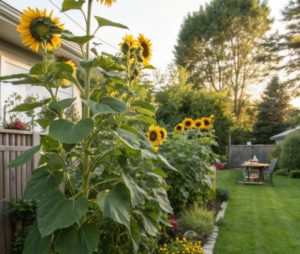
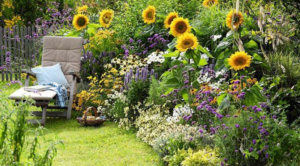
In a backyard garden, tall sunflowers may be planted along the fences, behind flower beds, or even along the boundaries of vegetable plots. They will add another layer to the landscaping design without any need for additional effort. When combined with low bushes or herbs, these flowers will make the plantation plot more lively and complete.
Moreover, sunflowers can be used for landscaping in bigger rural areas. A field of sunflowers will create a nice seasonal landscaping decoration for farms and country estates, especially when combined with the surrounding grass, trees, or other fall flowers.
For city dwellers, there is always a solution in the form of dwarf sunflowers that will look good on balconies, patios, entrances, and terraces.
How Can Sunflowers Add Value to an Ecological Garden?
It should not be forgotten that besides beauty, sunflowers have other advantages. Due to their large flower heads, they attract useful insects such as bees and butterflies. Sunflowers can complement flowering plants in the garden to form a more useful place for pollination when fewer flowers bloom.
The seeds of sunflowers are useful after the blooming period. Birds will use ripe seeds for feeding, and it is not necessary to cut off the flower heads immediately after blooming. Some mature plants left on the site will serve as food, as well as reduce garbage on the garden site.
Another important feature of sunflowers is that they can fit into the concept of ecological gardening. After rooting, they are drought-resistant, and there will be no need for constant watering. They can be combined with other plants adjusted to the local climate, and thus unnecessary irrigation will be eliminated.
However, the ecological garden does not mean untidiness in the arrangement of plants. They can be planted according to the principles of color and height distribution and at the same time serve as a place of living for insects and birds.
Conclusion
September cannot imply that it is already too late to grow sunflowers. For those who live where the autumn season is warm, there is a risk of late frost; selecting the right types of sunflowers and giving proper attention to the lighting, watering, and quality of soil will provide beautiful flowers for your enjoyment in the autumn season.
In any setting, whether it is backyards, farms, planters, or ecological gardens, sunflowers give us more than just seasonal beauty; we can use them to help our birds and pollinators and make our outdoors a little more wild and natural. Selecting the plants according to our local conditions is one of the simplest ways to have nice and environmentally friendly gardens.
0