In the cases of highway slope reinforcement, tunnel pre-support, and deep foundation pit construction, anchor stability is key to both overall structural integrity and longevity. Combining drilling, grouting, and anchoring in one integrated process, the
hollow injection bar has been widely accepted due to its efficiency and adaptability to unstable ground. Nevertheless, projects can greatly differ in terms of working loads, geological conditions, and corrosion resistance requirements. Poor choice of bar dimensions and/or steel grade leads to poor grouting, stuck drill bits, broken bars, and possible structural failures in the future. To ensure timely project execution within budget, here is a step-by-step guide to ground matching, calculations, drill bit choice, and vendor approval.
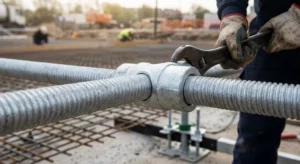
Matching Ground Conditions to Your Hollow Injection Bar Choice
The geological condition defines basic parameters that you need to consider when choosing your hollow injection bars. Self-drilling anchors have their bar used simultaneously as a drill rod, grout duct, and load-carrying member. Different ground conditions require different drilling approaches:
Broken Rock and Loose Soil
When using collapsed fill, sand-gravel formation, and highly weathered rock material, the standard boring case is not effective. The use of a hollow injection bar system will allow the drilling and grouting process to occur simultaneously, and it also ensures that the surrounding soil particles will be grouted, eliminating additional casing work.
Water Layers and Fault Formation
In water-bearing layers or faults, high-pressure grouting is needed. The inner bar clearance should provide for high grouting fluid delivery speed—normally 40–60 L/min to ensure full grout flow in the borehole.
Core Application Profiles:
- Tunnel Pipe Roofing & Canopy Support: Needs increased bending and shear resistance strength.
- Slope Stabilization & Excavation Support: Requires higher yield strength and resistance to creep.
- Micropile Foundation: Needs increased outer diameters and higher load-carrying capacity.
Choosing Specifications and Structural Parameters for a Hollow Injection Bar
In order to find accurate specifications of the hollow injection bar, accurate engineering figures are needed instead of visual estimates. The most important specifications are thread configuration, inner diameter/outer diameter (ID/OD), steel tensile strength, and surface protection layer thickness.
Common Bar Models and Mechanical Load Data
| Model |
Outer / Inner Dia. (OD/ID mm) |
Thread Type |
Yield Load (kN) |
Ultimate Load (kN) |
Typical Application Field |
| R32N |
32 / 18.5 |
R-Thread (Standard Rope) |
≥ 230 |
≥ 280 |
Light slope protection, small tunnel canopies |
| R32S |
32 / 15.0 |
R-Thread (Standard Rope) |
≥ 280 |
≥ 330 |
Medium load rock anchoring, tie-backs |
| T40/16 |
40 / 16.0 |
T-Thread (Trapezoidal) |
≥ 530 |
≥ 660 |
Deep foundation pits, anti-uplift piles |
| T76N |
76 / 51.0 |
T-Thread (Trapezoidal) |
≥ 1200 |
≥ 1600 |
Heavy micropiles, high-load tunnel umbrellas |
Thread Notes: R-type rope threads are ideal for bonding stress in light to medium bar sizes. T-type trapezoidal threads accommodate high torque, have balanced load-bearing and shear resistance capacity, and enable quick coupling downhole.
Anti-Corrosive Requirements
Surface coating selection is based on design service life, which is below 2 years for temporary structures and up to 50 to 100 years for permanent civil construction:
- Bare Black Steel: It is only used for temporary shoring.
- Hot-Dip Galvanizing: Zinc coating of about 80 μm (or mass of zinc of over 600 g/m²) protects steel from moisture and chemicals in the ground. Galvanized parts, such as ONTON’s galvanized hollow injection bar range, offer dependable performance during prolonged exposure to mildly acidic or neutral soil conditions.
- Epoxy Coating & Double Corrosion Protection (DCP): Required for aggressive environments with high concentrations of chlorides and severe industrial contamination or marine atmosphere.
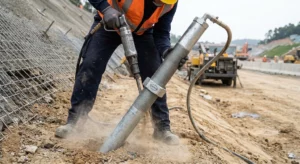
Pairing the Right Drill Bit and System Components with Your Hollow Injection Bar
An efficient hollow injection bar setup depends on well-matched drill bits and connection hardware. Installation process steps occur according to the established order: drilling rig is engaged to drive the drill bit, hollow bar is responsible for transmitting torque and cleaning the hole from chips. Further, the injection of the slurry is performed by means of a grout pump, and then the bearing plate and nut secure the structure to the rock face.
Drill Bit Classification
Choice of drill bit type is determined by rock hardness, fracture ratio, and soil density:
- Clay Bits – have wide blades to provide effective action in soft clayey and sticky silty soils.
- Cross Alloy Bits – developed for medium-hard and hard ground, weathered rock, and consolidated gravel with impact-resistant properties.
- Button Carbide Bits – made up of hard inserts (tungsten carbide) that allow drilling in hard and intact rocks.
Hardware Accessories
- Couplers: Connecting sleeves must match or exceed the full ultimate tensile capacity of the hollow bar to prevent joint separation during deep drilling.
- Bearing Plates and Nuts: Bearing plates (usually 200×200×12 mm) are designed to provide even distribution of loads at the soil face. Dome nuts with spherical washers correct deviations of up to 5° to 7°.
Quality Certifications and Industry Standards for Hollow Injection Bar Quality
The ground anchor system has little room for error after being installed. To confirm batch reliability before installing them, consider these quality factors:
International Factory Certification
Confirm ISO 9001 compliance for manufacturing, along with CE marking or European Technical Assessment (ETA).
Mill Test Certificates (MTC)
Each batch must have EN 10204 3.1 MTCs to prove chemical analysis (levels of C, Mn, Si) and physical testing (minimum yield, tensile strength, and elongation limit where elongation rate is 15%).
On-site Verification Through Pull Tests
Perform pull-out testing at 1.2–1.5 times the specified design load. The test will provide proof of the actual load-bearing capacity of the combination of grout body, anchor rod, and ground.
Supplier Evaluation and Cost Management
During the review of possible suppliers for your hollow injection bar, considering only the cost per meter may be deceptive. Remember that:
Project Cost Savings
Higher grade steel bars and accurate machining of the bits may be marginally more expensive initially, but will save on broken rod retrieval and bit clogging, along with reduced rig downtime.
Features of Customized Manufacturing
Well-experienced manufacturers such as ONTON manufacture a complete range of galvanized hollow injection bars and offer custom thread pitches, lengths, and custom drill bit designs in accordance with the ground report.
Timelines for Supply Chain
The timeline involved in ground engineering operations is very tight. Work with suppliers who have stock reserves, automated manufacturing plants, and international transportation facilities to ensure that no delays occur at the site of construction due to supply chain problems.
Conclusion
Choosing the suitable hollow injection bars for your project will depend on the condition of the ground along with its precise mechanical needs. By ensuring proper bar size (R32, T40, T76), the right corrosion coating, ground-related drill bits, and hardware fittings, you will be protecting your structural design from any soil movement. By relying on experienced manufacturers such as
ONTON, you will be able to get tested steel products along with quality control information.
0